

Description
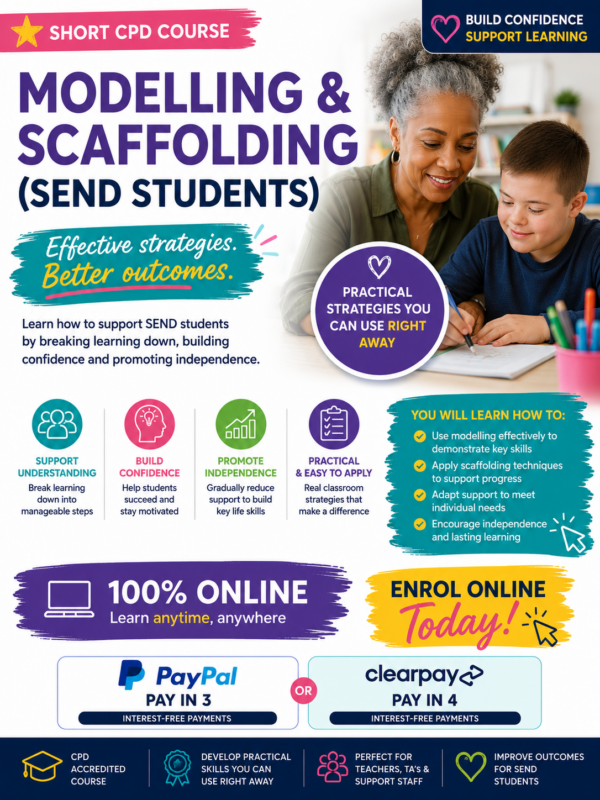
SEND E Learning Course. All students need cognitive support to help them problem solve, answer academic questions, and access the curriculum independently. This course will look at two teaching strategies in detail – modelling and scaffolding, and consider how teachers can coach their students to become independent learners, with specific advice for supporting Special Educational Needs and/or Disabilities (SEND) students in the classroom.
Learning outcomes
- You will understand different theories relevant to modelling and scaffolding, such as Albert Bandura’s social learning theory and Vygotsky’s Zone of Proximal Development (ZPD)
- You will know the different types of modelling and the importance of scaffolding and modelling, especially for students with SEND
- You will gain confidence in using these strategies successfully in the classroom
Advantages of this SEND E Learning course
- For pupils with additional needs, they’re often not equipped with the same educational experiences as their peers. Modelling learning tasks in a simple and manageable way and providing scaffolds in lessons can increase SEND students’ engagement, confidence, and independence. This course will provide a number of different practical strategies and academic readings on modelling and scaffolding to enable you to support your SEND students in the classroom.
- Websites, research, and video resources are utilised to explain modelling and scaffolding, and a good practice video demonstrates how to use a ‘think aloud’ to support problem solving
- Additional activities encourage you to reflect on the learning and underpin the knowledge you have gained
- There is also suggested extra reading that gives both practical information and links to websites to expand knowledge
View our full range of short SEN courses here.