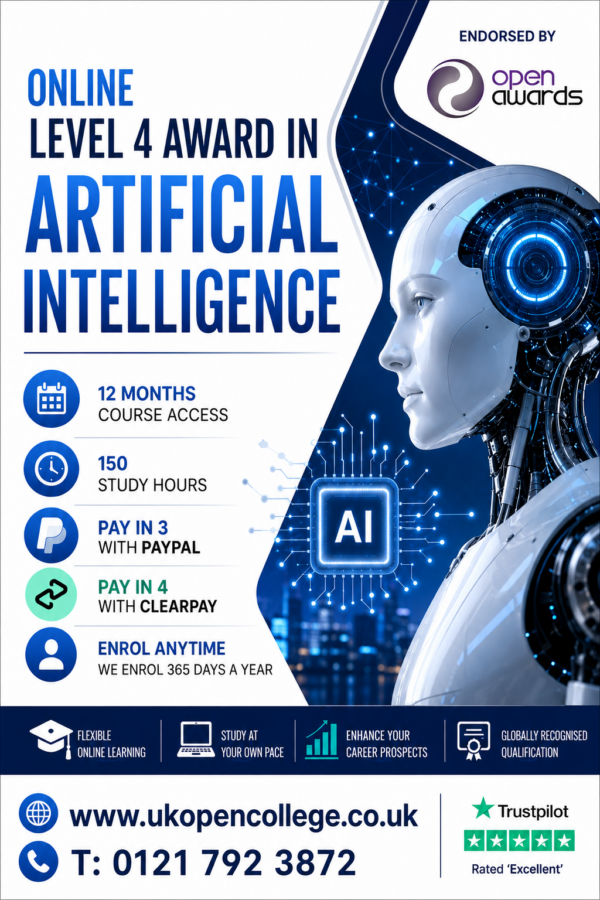

Artificial Intelligence (AI) Level 4 Award – Endorsed by Open Award

£225.00

Card Payments

Require a Company or School Invoice? You can request an invoice here.

    Description

    AI Level 4 Course. AI (Artificial Intelligence) refers to the simulation of human intelligence in machines, allowing them to perform tasks that typically require human cognition. These tasks include learning, reasoning, problem-solving, perception, and language understanding.

    There are different types of AI:

    • Narrow AI (Weak AI): Designed for specific tasks, like voice assistants (e.g., Siri, Alexa), recommendation systems, and self-driving car algorithms.
    • General AI (Strong AI): A hypothetical form of AI that would have human-like intelligence, reasoning, and adaptability across a wide range of tasks.
    • Super AI: A theoretical concept where AI surpasses human intelligence in all aspects.

    AI operates through various techniques such as machine learning, deep learning, and natural language processing, enabling it to analyse data, make decisions, and improve over time.

    Our Practical Artificial Intelligence – Level 4 Course takes you behind the scenes of this developing technology, providing everything you need to know, expressed in simple terms, to gain an understanding of the complex technologies behind AI, and including numerous hands-on practical exercises and projects using the Python programming language (all of the code is provided, and we even include a crash course in Python for those who need it).

    We investigate how computers are able to use historical data to learn how to make predictions, like forecasting a stock price movement or a cricket match score, how to recognise images, such as faces and traffic signs, and we dive under the hood to examine the technologies behind self-driving cars. We also explore the current state-of-the-art in robotics, including the use of AI-powered robotic arms in surgery and a range of manufacturing industries and delve into the techniques behind Natural Language Processing and automatic language translation.

    Each unit is designed to build on what you learned in the previous unit and the course is designed around the “learn-by-example” methodology, with a wide range of real-life examples provided to demonstrate new concepts as you learn them. You also get the chance to practice your skills with a variety of interesting exercises and assignments. You will even build your own neural network using advanced deep learning techniques!


    Qualification: Artificial Intelligence Level 4 Award – Endorsed by Open Awards
    Duration: 1-year course access & support included (150 hours Approx. overall)
    Start Date: Anytime – We enrol 365 days a year

    We have a full range of online computer courses that may be of interest, including Microsoft Office and Adobe Software courses!

    Course Syllabus

    Unit 1: Introducing AI

    This unit will help you to understand what AI needs to work successfully, together with the underlying technology, which we will find at work in several areas, including medicine, human interaction and aeronautics, to mention just a few. AI is also closely entwined with data analysis, machine learning, deep learning and neural networks.

    The following topics are covered:

    • Introduction
    • An overview of AI
    • The underlying technologies
    • The role of data
    • The use of algorithms
    • The development of specialised hardware
    • Unit review and quiz
    • Assignment 1 – Data analysis exercise


    Unit 2: Machine Learning

    As we know, machine learning (ML) relies on algorithms to analyse huge datasets and, although ML can’t think or feel like a human, it can perform predictive analytics far faster than a human and can help humans work more efficiently.

    This unit will introduce us to the tools we need to perform machine learning and will provide us with a solid understanding of how machine learning works.

    The following topics are covered:

    • Introduction
    • Preparing your machine learning tools
    • Python basics (1)
    • Python basics (2)
    • Understanding the maths
    • How machine learning works
    • How machine learning works with data
    • Examples of learning from data
    • Unit review and quiz
    • Assignment 2 – Iris machine learning project


    Unit 3: Learning from Smart and Big Data

    In this unit, we will learn how to obtain meaningful data, acquire enough data for the learner algorithm to work correctly, arrange the data into a matrix, deal with bad data, such as missing cases, distorted distributions, and anomalous examples, and create new features that are better suited to our algorithm.

    We will also discover how to understand data through similarity, work with some linear models and neural networks, deploy smart vector machines, and perform multiple levels of analysis using ensembles.

    The following topics are covered:

    • Introduction
    • Preprocessing data
    • Leveraging similarity
    • Working with linear models
    • The complexity of neural networks
    • Support Vector Machines (SVM)
    • Ensembles of learners
    • Unit review and quiz
    • Assignment 3 – Data cleaning project


    Unit 4: Apply learning to real problems

    In recent years, machine learning has often been used to classify images and read text for a variety of reasons and we start this unit by exploring techniques for obtaining image features for use in machine learning models, before moving on to investigate natural language processing.

    We also investigate a number of machine learning products and explore ways to improve machine learning models and study some guidelines for using data ethically.

    The following topics are covered:

    • Introduction
    • Classifying images
    • Working with text
    • Recommender systems
    • Ways to improve machine learning models
    • Guidelines for ethical data use
    • Machine learning packages
    • Unit review and quiz
    • Assignment 4 – Image recognition project


    Unit 5: Deep learning problems

    In recent years, machine learning has often been used to classify images and read text for a variety of reasons and we start this unit by exploring techniques for obtaining image features for use in machine learning models, before moving on to investigate natural language processing.

    We also investigate a number of machine learning products and explore ways to improve machine learning models and study some guidelines for using data ethically.

    The following topics are covered:

    • Introduction
    • Classifying images
    • Working with text
    • Recommender systems
    • Ways to improve machine learning models
    • Guidelines for ethical data use
    • Machine learning packages
    • Unit review and quiz
    • Assignment 4 – Image recognition project


    Unit 6: Practical AI

    All of us will have been exposed to some form of AI during our daily lives. If you shop on Amazon, you will be presented with items that other customers have bought together with your item (based on buying patterns generated by AI). If you talk to your smartphone and it understands what you want, that is speech recognition using AI at work.

    The following topics are covered:

    • Introduction
    • AI in computer applications
    • Automating common processes
    • Using AI for medical purposes
    • Improving human interaction
    • Robotics
    • Self-driving cars
    • Unit review and quiz
    • Assignment 6 – IPL cricket score predictor project


    Entry Requirements

    We recommend that learners have a sound general knowledge of IT and a good working knowledge of the Python programming language, but this is not a mandatory requirement.

    The hardware and software requirements include:

    • Intel or equivalent processor (multiple CPUs would be advantageous, but not required);
    • A graphics card (GPU) would be advantageous, but not required;
    • 2mb RAM;
    • 500mb available disk storage;
    • An Internet connection;
    • Windows, MacOS or Linux operating system;
    • Google Chrome browser.

    Assessment

    All of the assignments are projects or experiments that the learners are guided through. You will produce screenshots of the end-result to confirm completion of the project and these can be emailed to your course tutor by on completion of your training.

    Course Outcome

    On successful completion of this course students will receive our Advanced Diploma with feedback on your work and providing the assignments have been completed to the required standards students will also receive a Level 4 Open Awards Quality Endorsed Unit Course Certificate with 9 Open Awards Credits.

    The completion of this course alone does not lead to an Ofqual regulated qualification but may be used as evidence of knowledge and skills towards regulated qualifications in the future. To this end the learning outcomes of the course have been benchmarked at Level 3 against level descriptors published by Ofqual, to indicate the depth of study and level of difficulty involved in successful completion by the learner.

    You can find further information on qualifications/certificates and their levels on the Ofqual’s level descriptors page.

    The certification is issued through Open Awards. Open Awards are an Awarding Body Organisation approved by Ofqual. Set up in 1981, Open Awards (Previously the North West Region of the National Open College Network – OCNNW) have been in business for over 30 years and are a not for profit organisation and a registered charity.

    14 Day Money Back Guarantee

    Once course access has been provided you have 14 days to ensure this course meets your needs and requirements. If you are not happy for any reason at all, simply email our accounts department with your request to cancel on [email protected]. We will offer a full refund. No questions asked !

    Please note: Any request to cancel outside the 14 days cancellation period will be declined. We will not refund you under any circumstances outside of the legal 14 day cooling off period. If you have opted to finance your course with Paypal or Clearpay finance you are legally obliged to pay the balance of your fees once the 14 day period expires.

    Our full T’s & C’s can be viewed here.